
Portfolio
Selected Legal and Policy Work
Discover high-quality reports and analyses demonstrating expertise in investment law reform, sustainable development and investment dispute resolution
Featured Policy Briefs
PORTFOLIO: SELECTED LEGAL AND POLICY WORK

Brief 1:
Designing Sustainable Investment Treaties in East Africa
Operationalising Policy Space in the Era of ISDS Reform
EXECUTIVE SUMMARY
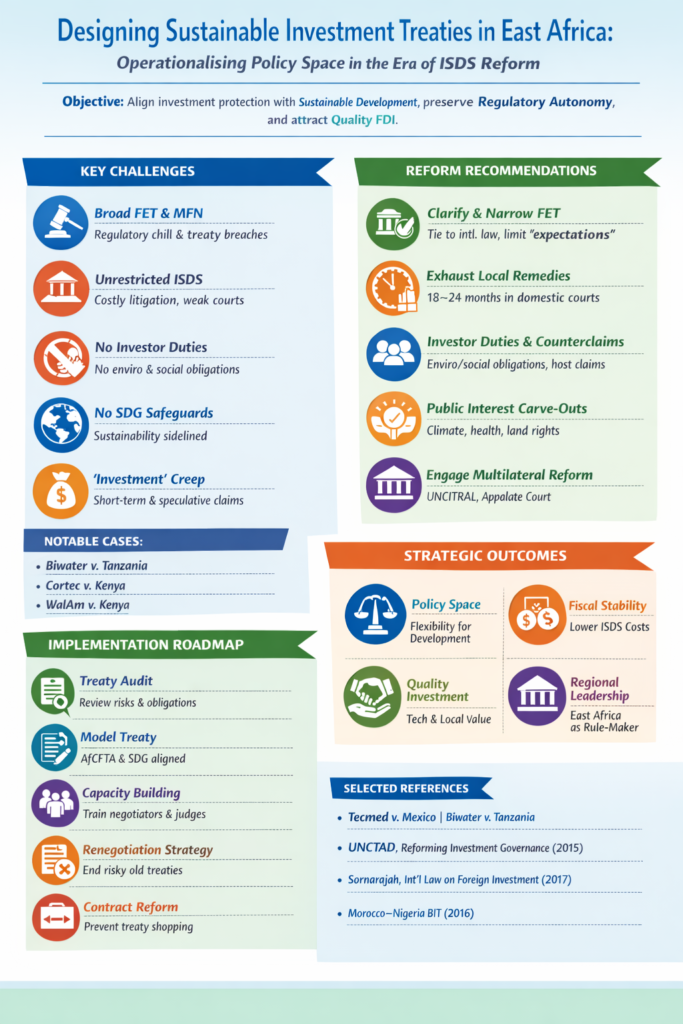
East African states face the dual imperative of attracting foreign investment and safeguarding regulatory autonomy to pursue sustainable development. Legacy bilateral investment treaties (BITs) contain broad substantive protections and unfettered access to Investor‑State Dispute Settlement (ISDS), which have cumulatively constrained policy space, exposed governments to costly arbitration, and generated regulatory chill.
Against this backdrop, states including Kenya, Uganda, and Tanzania are reassessing treaty commitments, renegotiating legacy agreements, and participating in global reform discussions at UNCITRAL Working Group III. This brief argues that East African governments must shift from reactive litigation management to proactive treaty design that aligns investment protection with sustainable development objectives.
Key reform proposals include: (1) narrowing and clarifying fair and equitable treatment (FET); (2) requiring exhaustion of local remedies; (3) embedding investor obligations and host‑state counterclaims; (4) articulating public‑interest carve-outs; and (5) engaging in multilateral ISDS reform. A sequenced implementation roadmap is outlined to guide institutional action.
OVERVIEW
Brief 2:
Embedding Community Participation in Investment Governance Frameworks
Beyond Procedural ISDS Reports
EXECUTIVE SUMMARY
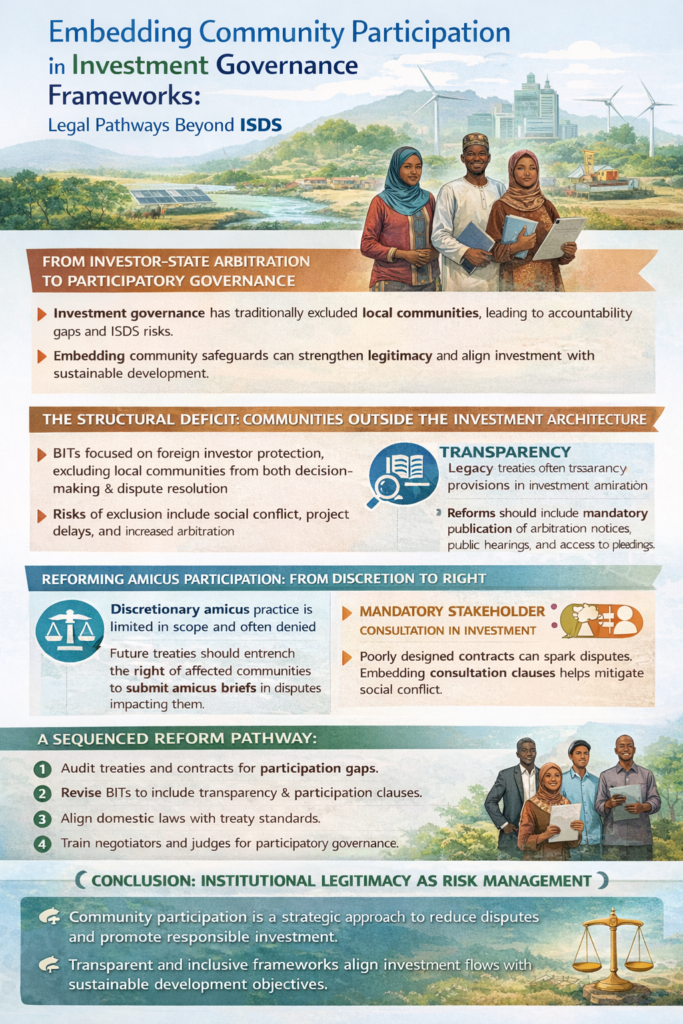
International investment governance largely functions on a bilateral basis, prioritising the investor-State relationship while often neglecting the communities affected by land, extractive, infrastructure, and agribusiness projects. Although reform efforts at UNCITRAL Working Group III have proposed improvements in transparency and procedural legitimacy, they do not adequately address the deeper democratic deficits in existing treaty structures.
This policy brief argues that community participation should not be viewed as an activist addition but as a vital strategy for reducing risks. By integrating transparency, mandatory consultations, participatory standing, and conditional investment protections into treaties and domestic laws, we can reduce the occurrence of disputes, protect public resources, and align investments with sustainable development goals. Reforms should aim to fundamentally reshape the foundations of investment governance, extending beyond the Investor-State Dispute Settlement (ISDS) system.
Case Analyses
PORTFOLIO: SELECTED LEGAL AND POLICY WORK