

A step-by-step guide to how an international arbitration moves from the emergence of a dispute to the recognition and enforcement of an arbitral award.
International arbitration is not a single hearing but a sequence of procedural stages. From the existence of consent to arbitration, through constitution of the tribunal and presentation of evidence, to the award and its enforcement. Each stage is governed by a combination of the parties’ agreement, applicable arbitration rules, the law of the seat, and, in international disputes, the wider legal framework governing the dispute.
Consent and the emergence of a dispute1
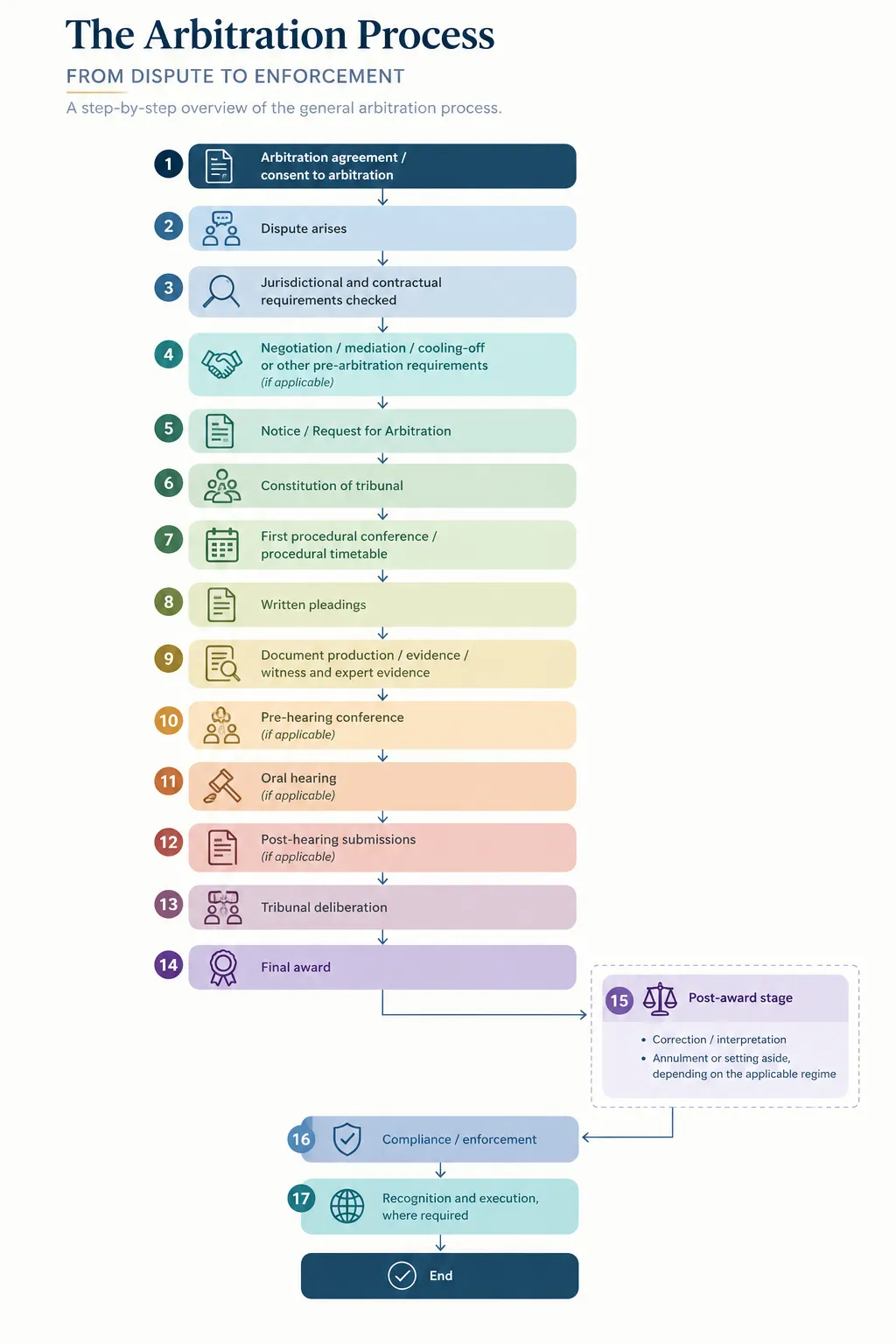
Arbitration begins with a valid basis for consent. This may be an arbitration clause in a contract, a subsequent agreement between the parties, or, in investment arbitration, consent contained in an investment treaty or domestic investment legislation. Once a dispute arises within the scope of that consent, the parties must determine whether the applicable instrument requires negotiations, mediation, a cooling-off period, or another step before arbitration can begin.
Commencing the arbitration2
Where the dispute remains unresolved, the claimant initiates the proceedings through the mechanism prescribed by the applicable rules, typically a Request for Arbitration or Notice of Arbitration. This establishes the formal commencement of the case and identifies the parties, the dispute, the basis of jurisdiction and the relief sought.
Establishing the tribunal and procedure3
The tribunal is then constituted in accordance with the parties’ agreement and applicable rules. Once constituted, it establishes the procedural framework for the case, including the timetable for written submissions, evidence, document production and any hearing.The tribunal may consist of a sole arbitrator or, where the applicable agreement or rules provide, a three-member tribunal, usually with a presiding arbitrator. Arbitrators are generally required to meet applicable standards of independence and impartiality and to disclose circumstances that may give rise to justifiable doubts about either.
Case Management/Preliminary Conference4
The tribunal and parties establish the framework for the arbitration, including its objectives and scope, key issues, procedural timetable and hearing dates. The conference may also address the identification and sequencing of factual and expert witnesses, document production, confidentiality, and any procedural or interim applications. These matters are typically recorded in a procedural order or timetable, providing a roadmap for the conduct of the proceedings through to the hearing and final determination.
Pleadings and evidence Stage5
The parties develop their respective cases through written pleadings and supporting evidence. Documents, witness statements and expert evidence may address both liability and, where relevant, the valuation of damages. The precise scope of disclosure and evidentiary procedure depends on the applicable rules and directions of the tribunal.

Hearings and determination in international arbitration6
The tribunal considers the parties’ written and oral submissions and may hear witnesses and experts. Following the completion of the proceedings, the tribunal deliberates and issues its award, determining the matters falling within its jurisdiction.
The award and post-award remedies7
An award is generally intended to be final and binding, although the applicable legal framework may provide limited mechanisms for correction, interpretation or challenge. These mechanisms are distinct from an appeal on the merits and are subject to the applicable arbitration law and procedural requirements.
Recognition and enforcement
Obtaining an award and enforcing an award are separate stages. Where voluntary compliance does not occur, the successful party may seek recognition and enforcement before a competent national court, including in jurisdictions where the losing party’s assets are located.
The New York Convention8 provides the principal international framework for the recognition and enforcement of foreign arbitral awards, subject to its requirements and the limited grounds for refusal recognised under the Convention and applicable national law.
Key Point:
Arbitration provides a structured mechanism for resolving a dispute, but the process does not necessarily end when the tribunal issues its award. For international disputes, the practical significance of an award may ultimately depend on whether it is recognised and enforced in the relevant jurisdiction.
Below is a Step By Step overview of the General Arbitration Process
- UNCITRAL, Model Law on International Commercial Arbitration (1985, amended 2006) arts 7, 8 and 16; UNCITRAL, Arbitration Rules (2021) arts 1–2. ↩︎
- UNCITRAL, Arbitration Rules (2021) art 3; ICSID, Arbitration Rules (2022) rr 2–6. ↩︎
- UNCITRAL, Model Law on International Commercial Arbitration (1985, amended 2006) arts 10–13; UNCITRAL, Arbitration Rules (2021) arts 6–13. ↩︎
- UNCITRAL, Notes on Organizing Arbitral Proceedings (2016); UNCITRAL, Arbitration Rules (2021) arts 17–27; ICSID, Arbitration Rules (2022) rr 29–30. ↩︎
- UNCITRAL, Arbitration Rules (2021) arts 20–29; ICSID, Arbitration Rules (2022) rr 30–31. ↩︎
- UNCITRAL, Arbitration Rules (2021) arts 28–34; ICSID, Arbitration Rules (2022) rr 32–36. ↩︎
- UNCITRAL, Model Law on International Commercial Arbitration (1985, amended 2006) arts 31–34; UNCITRAL, Arbitration Rules (2021) arts 34–43. ↩︎
- https://www.newyorkconvention.org/resources/uncitral/uncitral-new-york-convention-day-1999 ↩︎

Leave a Reply