

Investment v Commercial Arbitration: Same arbitral machinery: different legal relationship and stakes.
At first glance, investment arbitration under mechanisms like Investor-State Dispute Settlement (ISDS) under ICSID or UNCITRAL may look very similar to ordinary commercial arbitration. Both can involve an independent arbitral tribunal, written submissions, hearings, evidence, procedural orders and an award. Both are forms of arbitration and share substantial procedural architecture. Yet beneath that familiar machinery lies an important distinction: commercial arbitration generally resolves a dispute arising from a private commercial relationship, whereas investment arbitration addresses a dispute between a foreign investor and a State within a framework of international investment law.
The parties
The distinction begins with the parties and the legal relationship between them. Commercial arbitration generally involves private actors—for example, a dispute between two companies arising from a construction, supply, services, financing or other commercial agreement. Investment arbitration, by contrast, usually involves a foreign investor and the host State. The State is not simply another commercial counterparty. It is also a sovereign entity exercising public and regulatory powers. This gives investment disputes a distinctive public-law dimension that is generally absent from an ordinary commercial dispute.
Consent
The two forms of arbitration also differ in the source of consent to arbitration. In commercial arbitration, consent will ordinarily arise from an arbitration agreement, commonly contained in a contract between the parties. The parties agree that disputes falling within the scope of that agreement will be submitted to arbitration.
In investment arbitration, consent may arise from an investment treaty, domestic investment legislation, a contract or another legal instrument containing an offer to arbitrate. In the treaty context, for example, a State may provide its consent to arbitration in relation to qualifying investments and investors, with the investor accepting that offer by commencing proceedings. The arbitration agreement therefore need not be found in a contract directly negotiated between the investor and the State.
The Subject Matter of the Dispute
The subject matter of the dispute can also be fundamentally different. A commercial arbitration may principally ask whether one party breached its contractual or other commercial obligations. An investment arbitration may instead ask whether the State breached obligations owed to the investor under an investment treaty or other applicable international law. Depending on the applicable instrument, claims may concern standards such as fair and equitable treatment, expropriation, discrimination, full protection and security, national treatment or most-favoured-nation treatment. Investment arbitration can therefore engage questions of public international law, State responsibility and the exercise of sovereign regulatory powers.
This is particularly significant where the challenged State measure concerns public governance. An investment dispute may arise from measures relating to environmental regulation, taxation, land, natural resources, infrastructure, energy, public health or other areas of State regulation. The question is not simply whether a contractual obligation was performed, but whether the exercise of public power affected a protected investment in a manner prohibited by the applicable investment law. This creates a distinctive relationship between investment protection and the State’s right to regulate.
Investment disputes can also have a wider public dimension. An investment project may affect local communities, workers, land users, Indigenous peoples, consumers, environmental interests and public finances, even though those affected actors are generally not parties to the arbitration. This helps explain why questions concerning transparency, third-party participation, public interest and the legitimacy of ISDS have become important in the development and reform of the system.
So what makes ISDS distinctive?
Think of it this way:
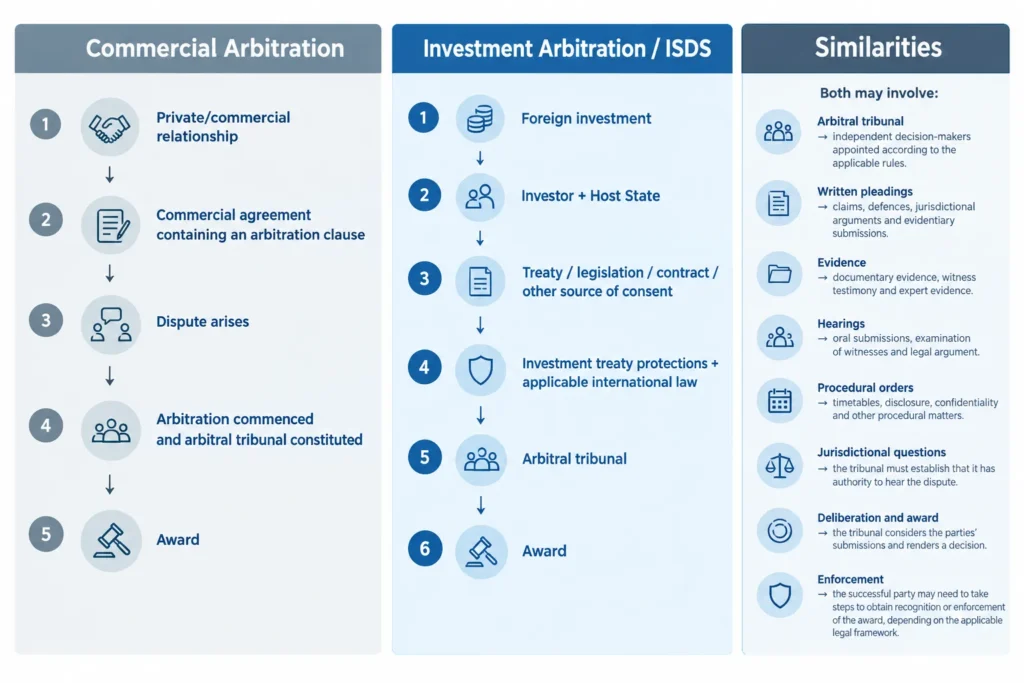
Similarities
Yet commercial arbitration and investment arbitration should not be treated as entirely separate procedural worlds. Investment arbitration is still arbitration. Both may involve an arbitral tribunal, written pleadings, documentary and testimonial evidence, expert evidence, hearings, procedural orders, jurisdictional questions, deliberation and an award. Depending on the applicable legal framework, the successful party may also need to take steps to obtain recognition or enforcement of the award.
Read more on Investment arbitration here:

Leave a Reply