

When Domestic Compliance Becomes a Jurisdictional Gatekeeper

Cortec Mining Kenya Limited, Cortec (Pty) Limited and Stirling Capital Limited v Republic of Kenya
ICSID Case No ARB/15/29
Award, 22 October 2018
The Dispute:
Cortec Mining v Kenya arose from the attempted development of a rare-earth and niobium mining project at Mrima Hill on the Kenyan coast. The claimants held a Special Prospecting Licence and subsequently obtained Special Mining Licence 351, which permitted exploitation of the project. Kenya later suspended and revoked the mining licence during a review of licences issued around the 2013 political transition.
The claimants alleged that Kenya had unlawfully interfered with their investment and brought proceedings under the UK–Kenya Bilateral Investment Treaty. The site was subject to several layers of domestic environmental and heritage protection.1At first sight, the dispute appeared to concern the State’s revocation of a mining licence. The more consequential question, however, was anterior to the merits: Did the claimants possess an investment capable of receiving treaty protection in the first place?
The jurisdictional question:
The UK–Kenya BIT did not contain an express provision stating that investments had to be made “in accordance with the laws” of Kenya. Kenya nevertheless argued that the claimants’ mining rights could not constitute a protected investment because the Special Mining Licence had been issued contrary to mandatory requirements of Kenyan law.The Tribunal therefore had to determine whether domestic legality could operate as an implicit condition of investment protection.2 This distinction is important. The question was not simply whether the claimants had breached environmental law. It was whether the alleged illegality affected the Tribunal’s jurisdiction ratione materiae by preventing the mining licence from constituting a protected investment.
The Tribunal’s Reasoning:
The Tribunal placed considerable weight on the investment’s legally constructed nature. A mining licence was not an asset existing independently of domestic law. Its legal existence, scope and economic value depended upon the host State’s regulatory regime. The Tribunal therefore reasoned that an investment consisting of a domestic licence had to be created under the host State’s law to qualify for international protection. It linked this conclusion both to the BIT’s concept of “investment” and to the ICSID Convention.3
The Tribunal did not adopt an absolute rule under which every regulatory irregularity would destroy treaty protection. It emphasised substantial compliance and drew a distinction between minor or inadvertent violations and breaches of important statutory requirements.4 That distinction became decisive because Mrima Hill was not an ordinary mining site. The Tribunal identified the site’s status as a forest reserve, nature reserve and national monument, together with the regulatory requirements associated with those classifications. The claimants had also been required to obtain an environmental impact assessment (EIA) licence before the relevant mining authorisation could lawfully take effect.5
The Tribunal found that the necessary EIA approval had not been obtained and that other statutory requirements had not been satisfied. It rejected the suggestion that informal political or administrative support could cure the absence of legally required approvals.6 The resulting conclusion was jurisdictional rather than merely regulatory: the Special Mining Licence was incapable of qualifying as a protected investment because it had not been lawfully created.
Why the case matters:
Cortec illustrates an important feature of investment law: domestic regulatory law can operate at the jurisdictional threshold of an international investment claim. This shifts the analytical sequence. The ordinary assumption might be:
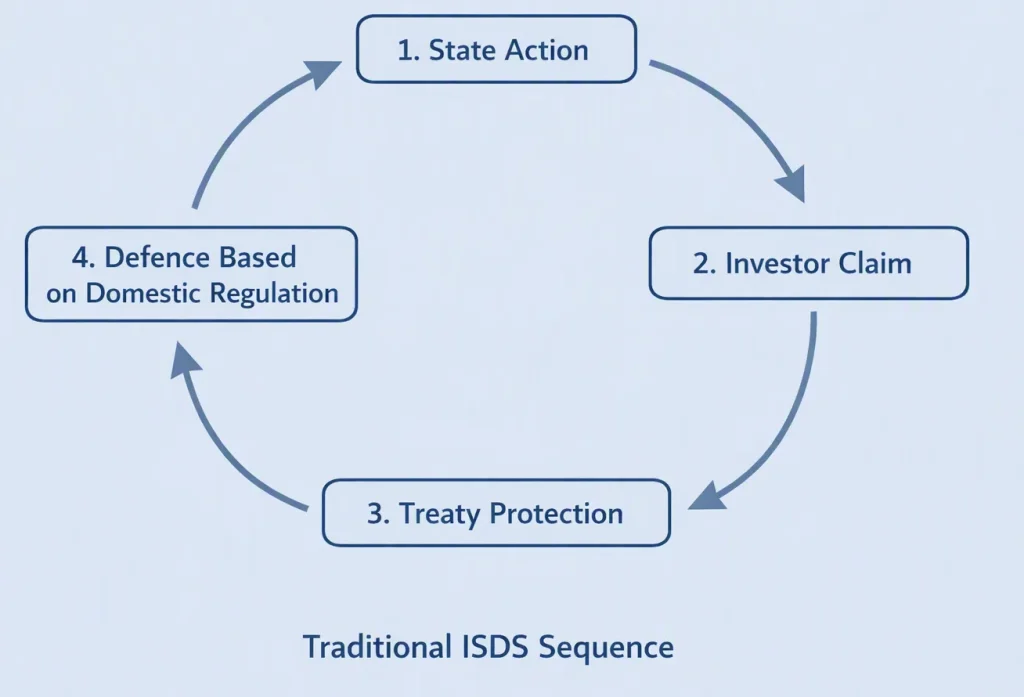
Traditional ISDS Sequence
Cortec V Republic of Kenya effectively reverses that sequence:
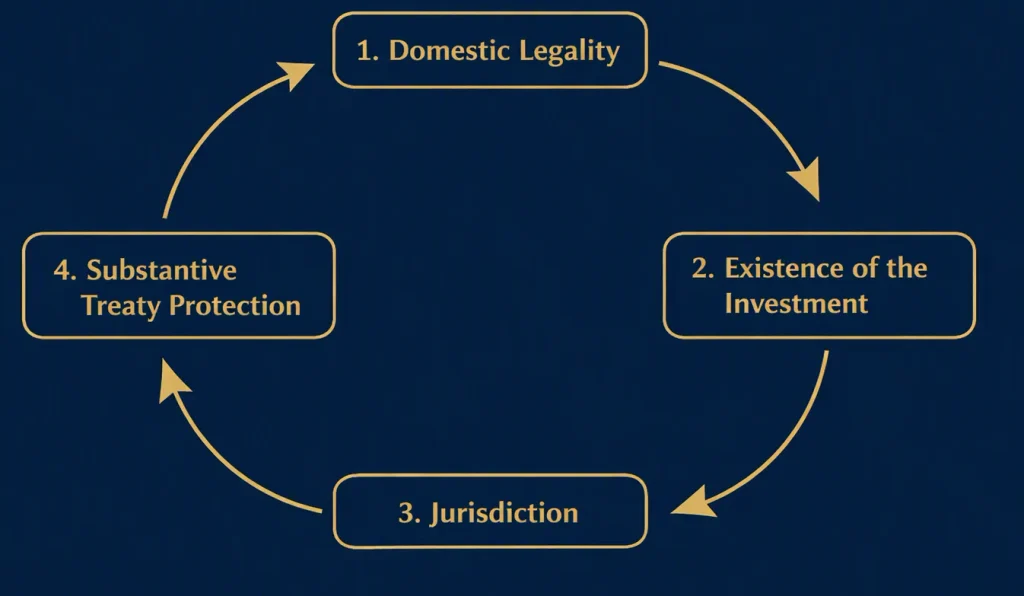
The distinction matters particularly in sectors such as mining, infrastructure and environmental services, where an investor’s rights are created through licences, concessions and administrative approvals. The case also demonstrates that environmental law can acquire significance in international investment arbitration without the tribunal deciding an environmental-rights claim as such. Here, EIA and conservation requirements were relevant because they determined whether the investment itself existed in legally cognisable form.
The Deeper Question:
The important theoretical issue is therefore not simply whether investors must obey domestic law. That proposition is relatively uncontroversial. The more difficult question is:
How much domestic regulatory non-compliance should be sufficient to remove an investment from the protection of international investment law?
The Tribunal answered through a substantial-compliance and proportionality framework. That creates a potentially important boundary between minor administrative irregularity and conduct serious enough to deprive an investor of treaty protection.7 For African investment governance, this makes Cortec especially significant. It places domestic environmental and administrative legality inside the architecture of international investment protection rather than treating those rules as merely internal matters.
Case takeaway
Cortec is not principally a case about whether Kenya could regulate mining. It is a case about when domestic legality determines whether international investment law applies at all.
See other Kenyan Case:
FOOTNOTES
- Cortec Mining Kenya Limited, Cortec (Pty) Limited and Stirling Capital Limited v Republic of Kenya (ICSID Case No ARB/15/29), Award, 22 October 2018, paras 42–43, 112, 116–17. ↩︎
- ibid, paras 244, 250, 258–62. ↩︎
- ibid, paras 254–62, 319. ↩︎
- ibid, paras 319–21. ↩︎
- ibid, paras 104, 112, 121, 138–58. ↩︎
- ibid, paras 157–58, 172–78, 320–21. ↩︎
- ibid, paras 320–43, 345–51, 365. ↩︎

Leave a Reply