
Understanding the ISDS institutions, rules and procedural frameworks that shape investor–State arbitration
Investor–State Dispute Settlement (ISDS) does not operate through a single international court.
Instead, investors and States may resolve investment disputes through several institutional and ad hoc mechanisms, depending on the consent contained in an investment treaty, investment contract, domestic investment legislation or other applicable instrument.The institutions differ in their mandates, procedural rules, administrative structures and geographical traditions.
Some are specifically associated with investment disputes; others are general international arbitration institutions that may administer investor–State proceedings when the applicable consent permits them.This guide provides a practical overview of the principal institutions and procedural frameworks encountered in ISDS
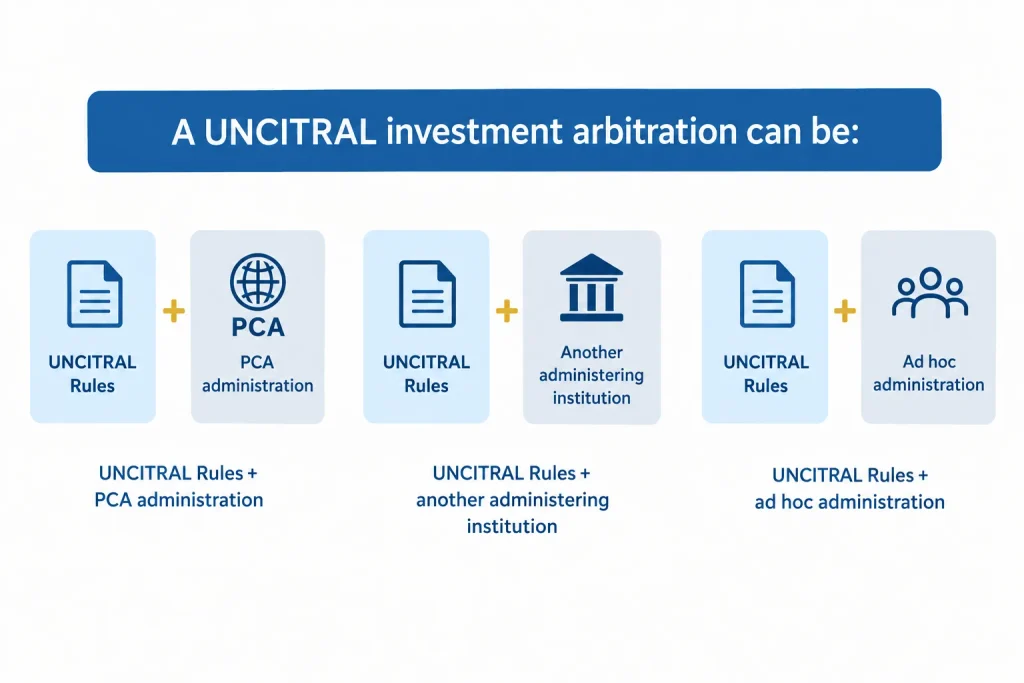
Important distinction: The United Nations Committee on International Trade Law (UNCITRAL) is not an arbitral institution in the same sense as International Center for Settlement of Investment Disputes (ICSID), the Permanent Court of Arbitration (PCA) or the International Chamber of Commerce (ICC). It develops procedural rules and other instruments that can govern investor–State proceedings. UNCITRAL proceedings may be administered by the PCA or another institution, or may proceed on an ad hoc basis.
Core international Institutions and frameworks
1) International Center for Settlement of Investment Disputes -ICSID

Established: 1966
Headquarters: Washington, D.C.
Institutional basis: Convention on the Settlement of Investment Disputes between States and Nationals of Other States (ICSID Convention)
The International Centre for Settlement of Investment Disputes (ICSID) is the principal international institution specifically established to provide facilities and administrative support for the resolution of international investment disputes. Its mandate covers arbitration and conciliation under the ICSID Convention, as well as proceedings under the ICSID Additional Facility and other procedural frameworks administered by the Centre. ICSID also provides mediation services.
As of 30 June 2026, ICSID had registered 1,118 arbitration and conciliation cases under the ICSID Convention and Additional Facility Rules. During FY2026, ICSID administered 363 cases, its highest number in a fiscal year.1
Matters commonly encountered:
ICSID proceedings cover a wide range of investment sectors, including:
Oil and gas;
Mining and extractive industries;
Electricity and renewable energy;
Infrastructure;
Transportation;
Construction;
Telecommunications;
Financial services;
Water and sanitation;
Agriculture;
Manufacturing;
Public services and other form of investments
In FY2026, oil and gas represented 25% of new ICSID cases, mining 18%, electric power and other energy 10%, finance 10%, transportation 8%, construction 7%, and services and trade 5%.2
Principal procedural frameworks
ICSID Convention Arbitration Rules
ICSID Convention Conciliation Rules
ICSID Additional Facility Arbitration Rules
ICSID Additional Facility Conciliation Rules
ICSID Mediation Rules
ICSID Fact-Finding Rules
UNCITRAL Arbitration Rules, where applicable and administered by ICSID
The current ICSID procedural framework was substantially revised in 2022.
Why ICSID matters
ICSID occupies a distinctive position because its institutional framework was created specifically for international investment disputes. Its Convention also establishes a specialised post-award system, including annulment proceedings, rather than relying exclusively on the ordinary supervisory jurisdiction of the courts of the arbitral seat.
2) Permanent Court of Arbitration (PCA)

Established: 1899
Headquarters: The Hague, Netherlands
Institutional basis: Hague Convention for the Pacific Settlement of International Disputes (1899)
The Permanent Court of Arbitration (PCA) provides administrative and registry services for international arbitrations and other dispute-resolution proceedings involving combinations of States, State entities, international organisations and private parties.
Unlike ICSID, the PCA is not limited to investment disputes.
It administers a substantial number of investor–State arbitrations, particularly proceedings conducted under the UNCITRAL Arbitration Rules. The PCA currently reports 90 arbitrations arising under bilateral or multilateral investment treaties or national investment laws.3
Matters commonly encountered
Investment treaties;
Energy and natural resources;
Mining;
Infrastructure;
Environmental regulation;
Maritime and territorial disputes;
Public contracts;
State concessions;
Taxation and regulatory measures; and
Disputes involving State-owned or State-controlled entities.
Principal procedural frameworks:
PCA Arbitration Rules
UNCITRAL Arbitration Rules
Applicable investment treaty provisions
Applicable national arbitration legislation
The PCA is particularly important in understanding UNCITRAL investment arbitration. UNCITRAL establishes the procedural rules; the PCA may provide the administrative machinery. The PCA therefore frequently acts as the registry or administering institution for cases that are procedurally governed by UNCITRAL rules.
3) Arbitration Institute of the Stockholm Chamber of Commerce (SCC)

Established: 1917
Headquarters: Stockholm, Sweden
Institutional basis: Stockholm Chamber of Commerce (SCC); SCC Arbitration Rules
The SCC Arbitration Institute administers international commercial and investment arbitrations.It has a particularly important history in treaty-based investment arbitration, including disputes involving European States, energy investments and post-Soviet investment relations.
Matters commonly encountered
SCC-administered investment disputes have included:
Energy;
Natural resources;
Mining;
Infrastructure;
Telecommunications;
Financial investments;
Regulatory measures; and
Disputes arising under bilateral and multilateral investment treaties.
Principal procedural framework
SCC Arbitration Rules
SCC Expedited Arbitration Rules, where applicable
Applicable investment treaty provisions
The SCC is one of the principal institutional alternatives to ICSID and UNCITRAL arbitration.
UNCTAD’s ISDS data identifies 57 known treaty-based cases administered by the SCC in its institutional dataset.
4) International Chamber of Commerce (ICC)

Established: 1923
Headquarters: Paris, France
Institutional basis: International Chamber of Commerce (ICC); ICC Arbitration Rules
A significant development for current users is that the 2026 ICC Arbitration Rules entered into force on 1 June 2026. They apply to arbitrations commenced from that date unless the parties have agreed to earlier Rules.
The ICC Rules address matters including:
Commencement of arbitration;
Constitution of the tribunal;
Jurisdiction;
Written submissions;
Evidence;
Hearings;
Interim measures;
Emergency arbitration;
Costs;
Srutiny of awards; and
The final award.
UNCTAD identifies the ICC among the principal institutions appearing in known treaty-based ISDS cases.
5) London Court of International Arbitration

Established: 1892
Headquarters: London, United Kingdom
Institutional basis: London Court of International Arbitration (LCIA); LCIA Arbitration Rules
The LCIA administers international arbitrations across a wide range of commercial and investment-related disputes.The LCIA is principally a general international arbitration institution rather than an investment-specific body.
Matters commonly encountered
Its work can encompass:
Energy;
Infrastructure;
Construction;
Financial services;
Technology;
Transportation;
Natural resources;
Corporate and contractual disputes; and
Disputes involving States and State entities.
Principal procedural framework
LCIA Arbitration Rules 2020. The Rules contain provisions dealing with: commencement; appointment and challenge of arbitrators; tribunal constitution, jurisdiction; written and oral evidenc, hearings; interim measures;emergency arbitrators; consolidation and joinder; confidentiality; costs and awards.
The current LCIA Rules took effect on 1 October 2020.
UNCTAD’s ISDS Navigator identifies a small number of known treaty-based cases administered by the LCIA.4
6) UNCITRAL — United Nations Commission on International Trade Law
Procedural framework rather than an arbitral institution
UNCITRAL develops international legal instruments designed to harmonise and modernise international trade and commercial law. In the ISDS context, its importance lies principally in its procedural rules and reform work.The UNCITRAL Arbitration Rules are widely used in investor–State arbitration, particularly where the applicable treaty permits arbitration under those Rules.

Established: 1966
Headquarters: Vienna, Austria
Institutional basis: United Nations General Assembly Resolution 2205 (XXI) (Not and arbitral Institution)
Principal procedural frameworks:
UNCITRAL Arbitration Rules
UNCITRAL Rules on Transparency in Treaty-based Investor-State Arbitration
UNCITRAL Code of Conduct for Arbitrators in International Investment Dispute Resolution
UNCITRAL Model Provisions on Mediation for International Investment Disputes
other instruments emerging from the UNCITRAL Working Group III ISDS reform process.
As of 2026, UNCITRAL’s ISDS reform programme includes work on procedural reform, dispute prevention and mitigation, an advisory centre, a possible standing mechanism, a permanent investment tribunal and an appellate mechanism. Something to note is that:
That distinction is important when reading investment arbitration cases.
Summary
| Body | Established | Headquarters | Institutional basis |
|---|---|---|---|
| ICSID | 1966 | Washington, D.C. | ICSID Convention |
| PCA | 1899 | The Hague, Netherlands | Hague Convention of 1899 |
| UNCITRAL (Not an institution but a framework) | 1966 | Vienna, Austria | UN General Assembly Resolution 2205 (XXI) |
| ICC | 1923 | Paris, France | International Chamber of Commerce; ICC Arbitration Rules |
| SCC | 1917 | Stockholm, Sweden | Stockholm Chamber of Commerce; SCC Arbitration Rules |
| LCIA | 1892 | London, UK | London Court of International Arbitration; LCIA Arbitration Rules |

Leave a Reply