

Two Procedural Pathways from Investment Disputes to Award and Enforcement
International investment disputes do not all proceed through the same procedural framework. Although ICSID and UNCITRAL arbitration are both frequently used in investor–State dispute settlement (ISDS), they operate within different legal architectures. Understanding that distinction is essential because the mechanism selected can affect how the arbitration is constituted, which procedural rules apply, how the award may be challenged, and how it is ultimately recognised and enforced.
This is illustrated through two hypothetical investment disputes involving the same parties: a French investor and the State of Kenya. The first dispute proceeds through ICSID Convention arbitration, while the second proceeds through UNCITRAL arbitration.
The purpose is not to suggest that one mechanism is inherently preferable to the other. Rather, the two examples demonstrate how the procedural framework surrounding an investment dispute changes depending on the arbitration mechanism selected. I explain various essential terms used in international arbitration here:
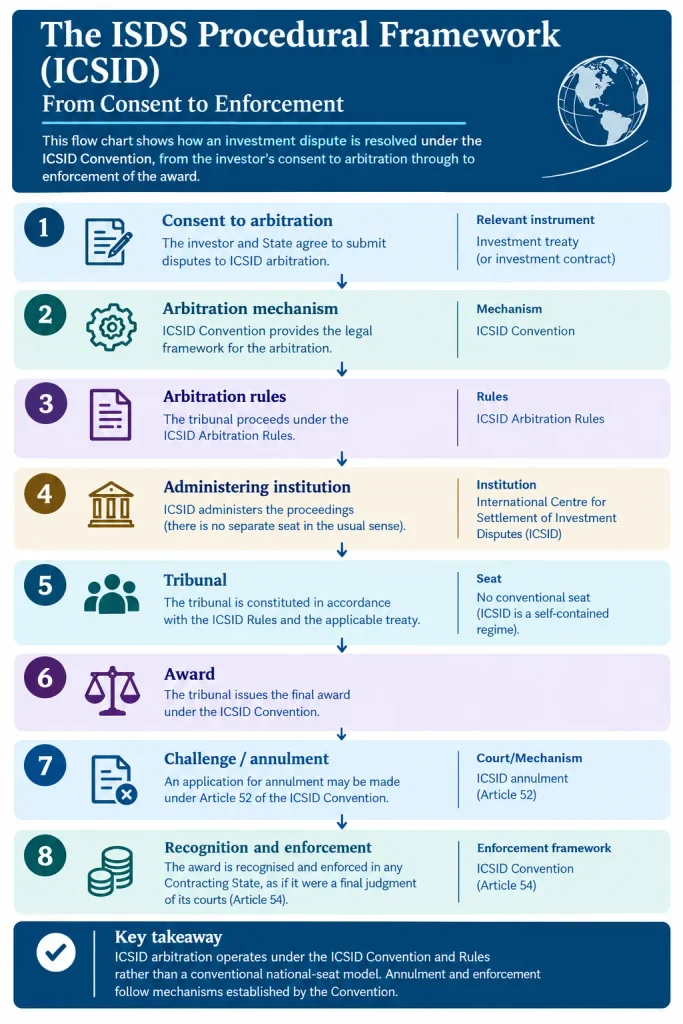
Scenario 1-ICSID
Hypothetical case
A French investor makes an investment in Kenya and later alleges that Kenya has breached its obligations under the applicable investment treaty. The treaty permits the investor to bring the dispute to arbitration under the ICSID Covention. France and Kenya are contracting states to the Convention.
Question:
What law and procedural framework govern the dispute?(In answering, explain how the ICSID Convention differs from non-ICSCID arbitration seated in a national jurisdiction, particularly in relation to the Seat of arbitration, national court supervision, annulment and enforcement.)
Identify:
The arbitration mechanism;
The arbitration rules;
The administering institution;
The seat of arbitration;
The lex arbitri;
The applicable substantive law;
The courts with supervisory jurisdiction;
Where a challenge/set-aside application may be brought; and
Where and under what framework the resulting award may be enforced.
Scenario 2 – UNCITRAL
Hypothetical case
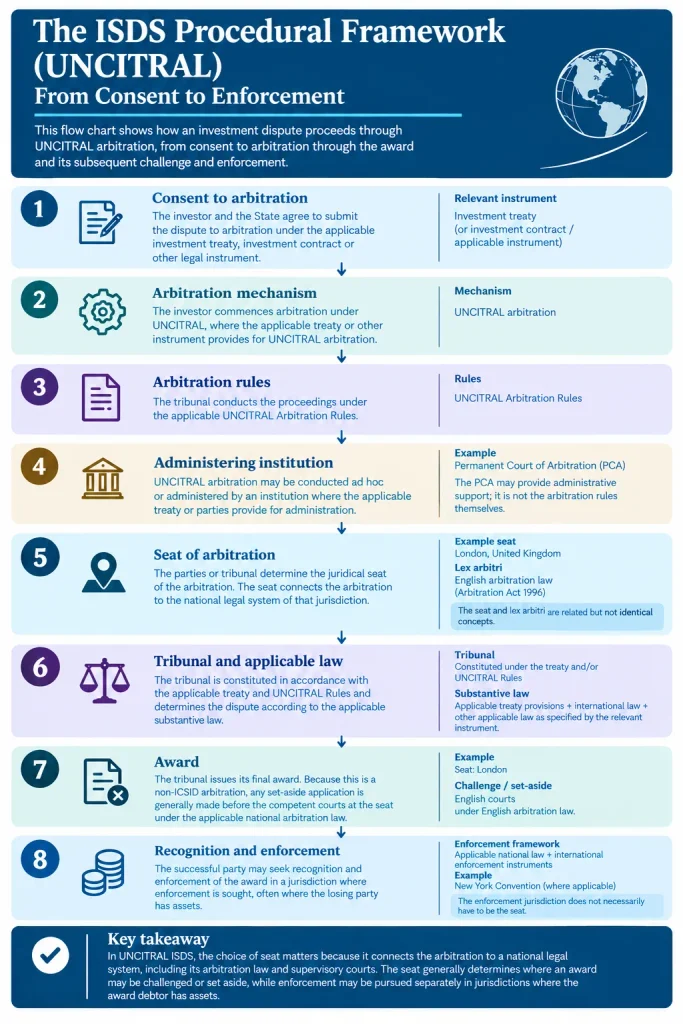
If the French investor chooses UNCITRAL arbitration, and the parties agree that the seat of arbitration will be London, England. Assuming that the proceedings are administered by the Permanent Court of Arbitration (PCA).
Question:
Using the questions from the first scenario, what law and procedural framework govern the dispute?
So Why does the seat of arbitration matter?
In a conventional international arbitration, the seat is the juridical place of the arbitration. It is not necessarily the location where hearings take place. More importantly, the seat connects the arbitration to the legal system of that jurisdiction. The arbitration is therefore generally subject to the arbitration law of the seat, often referred to as the lex arbitri, and the courts of the seat may exercise supervisory jurisdiction over the proceedings.
This can have significant procedural consequences:
For example, if an UNCITRAL arbitration has its seat in London, the arbitration will ordinarily be connected to the English legal framework governing arbitration. The courts at the seat may therefore have jurisdiction over applications concerning matters such as challenges to the award or other forms of judicial supervision provided for under the applicable law. The seat should therefore be distinguished from several other legal concepts that operate alongside it. See more on arbitration rules, lex libri, substantive law, law governing arbitration agreement and enforcement law here:
These concepts are interconnected, but they are not interchangeable.
The distinction becomes particularly important when an award is challenged. In a non-ICSID arbitration, such as UNCITRAL arbitration, a challenge or application to set aside the award will generally be connected to the courts of the seat, under the applicable national arbitration law. Enforcement, however, is a separate question. An award may need to be recognised and enforced in another jurisdiction, particularly where the respondent’s assets are located.
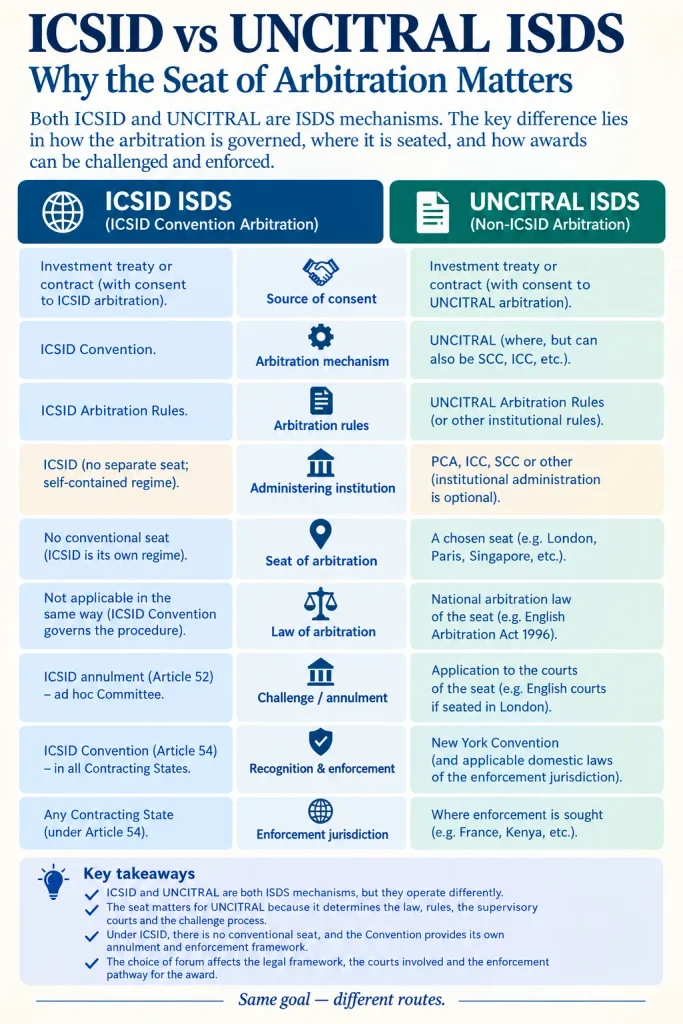
ICSID Convention arbitration follows a different model. The ICSID Convention establishes an autonomous procedural framework rather than operating through the conventional national-seat model applicable to ordinary international commercial or investment arbitration. It provides its own rules governing the conduct of proceedings, annulment and the recognition and enforcement of awards.
In particular, Article 52 establishes the mechanism for annulment,1 while Article 54 governs the recognition and enforcement of ICSID awards.2 By contrast, a non-ICSID award may be subject to recognition and enforcement proceedings before the courts of another jurisdiction under the applicable national law and, where applicable, the 1958 New York Convention on the Recognition and Enforcement of Foreign Arbitral Awards.3
The difference can therefore be expressed simply:
In UNCITRAL arbitration, the seat connects the arbitration to a national legal system. In ICSID Convention arbitration, the Convention provides the central procedural framework.
This raises a further question: how does the New York Convention operate in practice, and what does it mean for the recognition and enforcement of non-ICSID investment arbitration awards?
FOOTNOTES
- Convention on the Settlement of Investment Disputes between States and Nationals of Other States (opened for signature 18 March 1965, entered into force 14 October 1966) 575 UNTS 159, art 52. ↩︎
- Convention on the Settlement of Investment Disputes between States and Nationals of Other States, art 54 ↩︎
- Convention on the Recognition and Enforcement of Foreign Arbitral Awards (New York, 10 June 1958) 330 UNTS 3 (‘New York Convention’). ↩︎

Leave a Reply