

Reforming ISDS: From Dispute Settlement to Dispute Governance
Investor–State Dispute Settlement (ISDS) is no longer a settled field. For much of its modern history, investment arbitration developed through a network of bilateral investment treaties, multilateral instruments, investment contracts and arbitration rules. Tribunals interpreted treaty standards, States responded by renegotiating treaties and reforming domestic investment policies, and arbitral institutions refined their procedural frameworks.
That system is now undergoing its most significant period of institutional reconsideration in decades. The reform debate is not simply about whether investors should continue to have access to international dispute settlement. It concerns a much broader set of questions:
- Who should decide investment disputes?
- How should adjudicators be selected and regulated?
- Should investment disputes continue to be resolved principally through party-appointed tribunals?
- Should awards be subject to appellate review?
- Can disputes be prevented before they become arbitrations?
- How should third-party funding be regulated?
- How should States defend counterclaims?
- What role should domestic courts and domestic remedies play?
- Should investment disputes increasingly be resolved through State–State mechanisms rather than direct investor claims?
- And what I would consider most important: How can an investment regime contribute to sustainable development, environmental protection, responsible business conduct and the interests of affected communities?
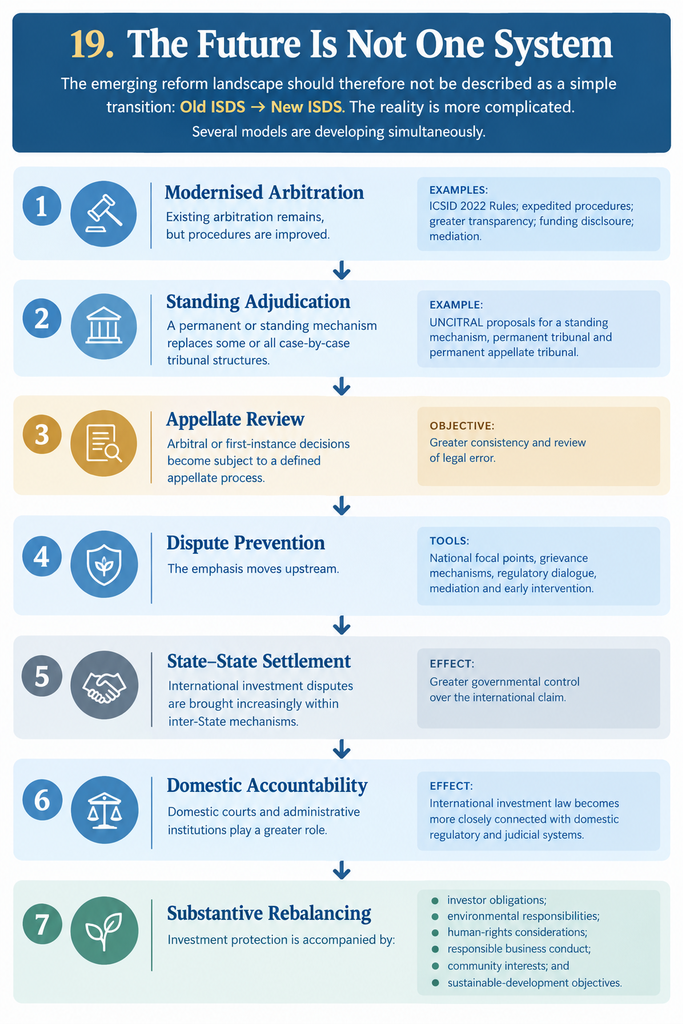
There is no single answer emerging from the reform process. Instead, several reform pathways are developing simultaneously.
At the multilateral level, the principal process is UNCITRAL Working Group III on Investor-State Dispute Settlement Reform. Alongside it, the International Centre for Settlement of Investment Disputes has modernised its procedural rules, expanded mediation and introduced new provisions addressing transparency and third-party funding.
The future of ISDS is therefore unlikely to be determined by one reform alone. It is more accurately understood as a movement from dispute settlement towards dispute governance.
1) UNCITRAL Working Group III: The Global Reform Process
In 2017, the United Nations Commission on International Trade Law (UNCITRAL) gave Working Group III a broad mandate to work on the possible reform of ISDS.1 The Working Group first identified three broad concerns:inconsistency, incoherence, unpredictability and perceived incorrectness of arbitral decisions;concerns relating to arbitrators and other decision-makers; and the cost and duration of ISDS proceedings.2
What followed was NOT a proposal for one predetermined replacement system. The Working Group was instead instructed to develop possible solutions while allowing States to determine which reforms they wished to adopt and to what extent.3 This is important. The UNCITRAL process is therefore better understood as a menu of reform options rather than a single blueprint for abolishing or replacing arbitration.
By 2026, the reform programme had developed into several interconnected workstreams, including:
A possible multilateral instrument to implement reforms;
Procedural and cross-cutting reforms;
Investment mediation;
Dispute prevention and mitigation;
A multilateral advisory centre;
Codes of conduct;
A possible standing mechanism;
A permanent tribunal;
A permanent appellate tribunal; and
Guidance concerning damages and compensation.4
The process remains ongoing. As of October 2026, UNCITRAL Working Group III has completed its 54th session and held its tenth intersessional meeting, while its 55th session is scheduled for 12–16 October 2026. UNCITRAL describes the Working Group as approaching the final stages of its ISDS reform work, but several institutional questions remain under consideration.5
The future of ISDS is therefore being negotiated rather than already determined.
2. From Ad Hoc Arbitration to a Permanent Tribunal?
One of the most consequential reform proposals is the possible establishment of a standing mechanism for the resolution of international investment disputes. Traditional investment arbitration is normally constituted on a case-by-case basis. The disputing parties appoint arbitrators, subject to the applicable treaty and arbitration rules. A new dispute can therefore produce a new tribunal, with a new composition and potentially different approaches to questions that have arisen in earlier cases. The proposed standing mechanism seeks to address some of the concerns associated with this structure.
UNCITRAL has developed draft texts concerning a standing mechanism and, more specifically, draft statutes for:
A Permanent Tribunal for International Investment Disputes; and
A Permanent Appellate Tribunal for International Investment Disputes.6
These are not merely renamed arbitral tribunals. A permanent adjudicatory structure raises questions about institutional independence, appointment, tenure, remuneration, jurisdiction, chamber composition, applicable law, procedural rules, transparency and the relationship between the new institution and existing investment treaties.
It also raises a deeper constitutional question:
Should investment disputes continue to be determined principally through temporary, party-appointed tribunals, or should international investment law move towards a more permanent adjudicatory institution?
The answer has implications extending beyond procedure.
A standing tribunal could potentially facilitate greater institutional continuity and the development of a more coherent body of jurisprudence. But it would also require States to agree on the institutional architecture and relationship between the new mechanism and their existing treaty commitments. The current UNCITRAL documents should therefore be read as draft institutional architecture, not as evidence that a global investment court already exists.7
3. The Appellate Mechanism: Should Investment Awards Be Reviewable?
A related reform concerns the creation of an appellate mechanism.The traditional arbitral model generally gives considerable weight to finality. Under many investment arbitration frameworks, there is no general appeal on the merits.
ICSID, for example, provides specific post-award remedies under the ICSID Convention, including interpretation, revision and annulment, but annulment is not a general appeal.8
The possibility of an appellate mechanism would change that architecture. An appellate body could potentially review errors of law, questions of treaty interpretation or other defined grounds of appeal. The objective would be to promote greater consistency and correctness across investment decisions.
But an appellate mechanism creates its own institutional questions:
- What decisions would be appealable?
- Would appeals be limited to questions of law?
- Could factual findings be reviewed?
- Would an appeal suspend enforcement?
- How would existing treaty commitments be incorporated?
- Would States have to consent to the new appellate jurisdiction?
- How would the appellate mechanism interact with ICSID annulment?
- Would additional review increase the duration and cost of proceedings?
UNCITRAL has been examining these questions for several years, including the relationship between an appellate mechanism and enforcement of investment awards.9 The debate therefore involves a trade-off between finality and review. Too little review may leave inconsistent interpretations uncorrected. Too much review may transform a system criticised for cost and duration into an even longer appellate process. The institutional challenge is not simply to create another level of adjudication. It is to determine what kind of review is necessary, for what purpose and at what procedural cost.
4. Codes of Conduct: Regulating the Decision-Makers
Institutional reform is only part of the story. The legitimacy of investment adjudication also depends upon the people who decide cases. Investment arbitration has historically operated through party-appointed arbitrators. This has generated debate concerning independence, impartiality, conflicts of interest, repeat appointments, issue conflicts and the broader professional structure of international adjudication.
UNCITRAL and ICSID therefore worked jointly on a Code of Conduct for Adjudicators in International Investment Dispute Resolution. The UNCITRAL Code of Conduct for Arbitrators was adopted in 2023. A separate Code of Conduct for judges was also adopted in principle in 2023 in connection with the proposed standing adjudicatory mechanisms.10 The Code addresses matters including:
- independence and impartiality;
- conflicts of interest;
- disclosure;
- repeat appointments;
- relationships with counsel and other participants; and
- obligations relating to the integrity of the adjudicative process.11
The significance of the Code is broader than professional ethics. It represents an attempt to establish common standards across a fragmented investment-dispute system. A permanent investment court would still require judges. Arbitration would still require arbitrators. Mediation would still require mediators. The reform question is therefore not simply who appoints decision-makers, but also what standards govern their conduct once appointed.
5. ICSID Reform: Modernising the Existing System
While UNCITRAL has been considering structural reform, ICSID has pursued substantial procedural modernisation within the existing arbitration framework. The 2022 ICSID Rules and Regulations, which entered into force on 1 July 2022, represented the Centre’s most extensive revision of its procedural rules since 2006.12
The reforms sought to modernise, simplify and streamline proceedings. They include measures concerning:
- case management;
- time limits;
- expedited arbitration;
- electronic filing and communication;
- transparency;
- publication of orders, decisions and awards;
- protection of confidential and personal information;
- third-party funding;
- mediation; and
- fact-finding.13
The reforms are significant because they demonstrate that ISDS reform does not necessarily require replacing arbitration. Some problems can be addressed through procedural redesign. The result is a useful distinction:
UNCITRAL reform asks, among other things, whether the institutional architecture of ISDS should change. ICSID reform demonstrates how the existing architecture can itself be modernised.
These approaches are not mutually exclusive.
6. Mediation: Moving from Adjudication to Resolution
One of the most important changes in contemporary investment dispute settlement is the increasing emphasis on mediation. Arbitration is adversarial and adjudicatory. Mediation is consensual. An independent mediator assists the parties in identifying and negotiating a mutually acceptable resolution, without imposing a binding determination on them.
ICSID introduced dedicated Mediation Rules in 2022.14 They can apply to investment-related disputes involving States, State entities and regional economic integration organisations, and they do not require the nationality or ICSID Convention membership conditions applicable to ICSID Convention arbitration.15
UNCITRAL has followed a similar path. In 2023, it adopted:
Model Provisions on Mediation for International Investment Disputes; and
Guidelines on Mediation for International Investment Disputes.16
This represents a conceptual shift. Instead of asking:
How should an investment dispute be adjudicated?
the reform process also asks:
How can the dispute be resolved before adjudication becomes necessary?
That leads directly to another reform area: dispute prevention.
7. Dispute Prevention: The Most Important Arbitration May Be the One That Never Happens
Investment dispute prevention has received increasing attention because many disputes develop over time. A disagreement may begin as:
- a licensing problem;
- a regulatory delay;
- a tax assessment;
- a change in environmental requirements;
- a concession dispute;
- a permit problem;
- a disagreement over compensation;
- an administrative decision; or
- a breakdown in communication between an investor and government agency.
By the time a notice of arbitration is filed, the dispute may already have become institutionally entrenched.
Prevention therefore seeks to intervene earlier.UNCITRAL adopted its Toolkit on Prevention and Mitigation of International Investment Disputes in 2025.17 The Toolkit complements the earlier work on investment mediation and dispute prevention.
This is particularly relevant to developing States. The ability to identify disputes early can depend on domestic institutional arrangements: investment ombudsmen, grievance mechanisms, national focal points, inter-agency coordination, regulatory dialogue and structured investor–State communication. The significance is therefore wider than arbitration. Dispute prevention moves ISDS upstream—from the tribunal room into investment governance itself.
8. Transparency: From Private Arbitration to Public Accountability
Transparency is another major component of ISDS reform. Investment disputes can concern public regulation, taxation, environmental protection, public health, natural resources and essential infrastructure. The outcome may therefore affect interests extending far beyond the investor and State appearing before the tribunal.
UNCITRAL’s response includes the UNCITRAL Rules on Transparency in Treaty-based Investor–State Arbitration, which entered into effect in 2014, and the Mauritius Convention on Transparency, which entered into force in 2017.18 The UNCITRAL Transparency Registry provides public access to information and documents from covered treaty-based investment arbitrations.19 The significance is constitutional as much as procedural.
Traditional commercial arbitration developed around privacy and party autonomy. The significance is constitutional as much as procedural. That difference creates a powerful justification for transparency. But transparency is not absolute. Confidential business information, protected personal information, national security and other legitimate interests may justify restrictions.
The contemporary reform question is therefore not:
“Should ISDS be transparent?”
It is:
“What level of transparency is appropriate for a dispute involving public power and private investment?”
9. Third-Party Funding: Who Is Financing the Claim?
Third-party funding has become an important issue in investment arbitration. A funder may finance some or all of a party’s legal costs in return for remuneration, potentially linked to the outcome of the proceedings. Funding can affect access to dispute settlement, particularly where arbitration is expensive and prolonged.
But it can also raise questions about:
- conflicts of interest;
- security for costs;
- disclosure;
- control of proceedings;
- settlement decisions;
- costs allocation; and
- the relationship between funders, counsel and parties.
The 2022 ICSID Arbitration Rules responded directly to this issue. Rule 14 requires a party to disclose the name and address of a non-party from which it has received funding for pursuing or defending the proceeding where the funding falls within the rule’s definition of third-party funding.20UNCITRAL Working Group III has separately considered third-party funding as part of its procedural and cross-cutting reform work.21 This is significant because third-party funding transforms what might otherwise appear to be a bilateral dispute into a more complex financial relationship.
The regulatory question is therefore not simply whether funding should be permitted.
It is how funding can be accommodated without undermining the integrity and independence of the proceedings.
10. Counterclaims: The State as Respondent—and Sometimes Claimant
Traditional descriptions of ISDS tend to portray the investor as claimant and the State as respondent. That model is incomplete.
Investment disputes can also involve counterclaims by States. ICSID Convention Article 46 permits a tribunal to determine incidental or additional claims or counterclaims arising directly out of the subject matter of the dispute, provided they fall within the parties’ consent and the Centre’s jurisdiction.22 The 2022 ICSID Arbitration Rules further regulate ancillary claims and counterclaims.23
The significance of counterclaims extends beyond procedural symmetry.They raise the possibility that an investment arbitration can become a forum for examining investor conduct, not merely State conduct.This is particularly important where disputes involve:
- environmental damage;
- human rights;
- corruption;
- contractual breaches;
- regulatory violations;
- labour standards; or
- failures to comply with domestic law.
Cases such as Urbaser v Argentina demonstrated the potential significance of State counterclaims in investment arbitration.24 UNCITRAL Working Group III has also considered counterclaims as part of its broader procedural reform work, including questions concerning jurisdictional connections between claims and counterclaims and how counterclaims interact with cost, duration and third-party funding.25
From a one-directional model of State obligations toward a more reciprocal examination of investor and State responsibilities.
11. Domestic Remedies: Should International Arbitration Come First?
Another unresolved question concerns the relationship between international investment arbitration and domestic legal systems. Traditional investment treaties have often permitted investors to bring international claims without requiring them to exhaust domestic remedies. That structure can place international arbitration in a position of considerable importance relative to domestic courts.
Reform proposals increasingly examine whether some disputes should first be addressed through:
- domestic administrative procedures;
- regulatory grievance mechanisms;
- domestic courts;
- negotiation;
- mediation;
- cooling-off periods; or
- other dispute-prevention mechanisms.
This does not necessarily mean imposing a universal requirement to exhaust domestic remedies.
Rather, it raises the question of subsidiarity:
When should an international investment tribunal intervene, and when should the dispute first be addressed within the host State’s domestic legal order?
The answer can have major implications for access to justice, regulatory governance and the relationship between international and domestic law.
For African States, this issue is particularly important because domestic institutions are not merely potential alternatives to international arbitration. They are part of the broader architecture through which investment governance is implemented.
12. State–State Dispute Settlement: Rebalancing the Architecture
Another possible direction is greater use of State–State dispute settlement.
Under a State–State model, an investor does not necessarily bring the international claim directly. Instead, the investor’s home State may bring proceedings against the host State. This resembles traditional diplomatic protection more closely than modern investor–State arbitration.
State–State mechanisms can provide governments with greater control over the initiation and conduct of disputes. But they also alter the investor’s position. The investor no longer necessarily controls the claim. The home State must decide whether to pursue it.
This raises familiar questions about diplomatic discretion and the relationship between private economic interests and broader foreign-policy considerations.State–State mechanisms are therefore not simply a technical alternative to ISDS.They represent a different conception of who owns the international dispute.
Summary
FOOTNOTES
- UNCITRAL, ‘Investor-State Dispute Settlement Reform’ (Working Group III mandate originating from UNCITRAL’s 50th session, 2017). ↩︎
- UNCITRAL, Report of Working Group III (Investor-State Dispute Settlement Reform) on the Work of its Thirty-Seventh Session, UN Doc A/CN.9/970 (2018); see also UNCITRAL, Report of Working Group III on the Work of its Thirty-Eighth Session, UN Doc A/CN.9/1004 (2019). ↩︎
- UNCITRAL, ‘Investor-State Dispute Settlement Reform’, explaining that solutions are toallow States choice as to whether and to what extent they adopt relevant reforms. ↩︎
- UNCITRAL, ‘Working Group III: Investor-State Dispute Settlement Reform’, materials for the 50th–54th sessions. ↩︎
- UNCITRAL, ‘10th Intersessional Meeting of UNCITRAL Working Group III’ (11 September 2026); UNCITRAL, ‘Working Group III: Investor-State Dispute Settlement Reform’, 54th and 55th sessions. ↩︎
- UNCITRAL, Possible Reform of Investor-State Dispute Settlement (ISDS): Draft Statute of a Permanent Tribunal for International Investment Disputes, UN Doc A/CN.9/WG.III/WP.259 (2026); Draft Statute of a Permanent Appellate Tribunal for International Investment Disputes, UN Doc A/CN.9/WG.III/WP.260 (2026). ↩︎
- See generally UNCITRAL, ‘Permanent Tribunal and Permanent Appellate Tribunal for International Investment Disputes’, which identifies these instruments as draft statutes within the ongoing reform process. ↩︎
- Convention on the Settlement of Investment Disputes between States and Nationals of Other States (opened for signature 18 March 1965, entered into force 14 October 1966) arts 49–52; see also ICSID, Post-Award Remedies – ICSID Convention Arbitration (2022 Rules). ↩︎
- UNCITRAL, ‘Appellate Mechanism’, including Possible Reform of Investor-State Dispute Settlement (ISDS): Appellate Mechanism, UN Doc A/CN.9/WG.III/WP.224, and earlier work on appellate and multilateral court mechanisms. ↩︎
- UNCITRAL, ‘Codes of Conduct’, UNCITRAL Code of Conduct for Arbitrators in International Investment Dispute Resolution and Commentary (2023); UNCITRAL Code of Conduct for Judges in International Investment Dispute Resolution and Commentary (adopted in principle 2023). ↩︎
- ibid ↩︎
- ICSID, ‘ICSID Rules and Regulations Amendment’ (2022). ↩︎
- ICSID, ‘ICSID Releases 2022 Versions of its Rules and Regulations’ (2022). ↩︎
- ICSID, ‘ICSID, Mediation Rules‘ (2022). ↩︎
- ibid ↩︎
- UNCITRAL, Model Provisions on Mediation for International Investment Disputes (2023); UNCITRAL, Guidelines on Mediation for International Investment Disputes (2023). ↩︎
- UNCITRAL, Toolkit on Prevention and Mitigation of International Investment Disputes (2025). ↩︎
- UNCITRAL, Rules on Transparency in Treaty-based Investor-State Arbitration (effective 1 April 2014); United Nations Convention on Transparency in Treaty-based Investor-State Arbitration (Mauritius, 2014), entered into force 18 October 2017. ↩︎
- UNCITRAL, ‘Transparency Registry’. ↩︎
- ICSID Arbitration Rules (2022), r 14. ↩︎
- UNCITRAL, ‘Third-party Funding’; see also UNCITRAL, Possible Reform of Investor-State Dispute Settlement (ISDS): Draft Provisions on Procedural Reform, UN Doc A/CN.9/WG.III/WP.219. ↩︎
- ICSID Convention, art 46. ↩︎
- ICSID Arbitration Rules (2022), r 48. ICSID explains that counterclaims must arise directly out of the same subject matter, fall within the parties’ consent and satisfy Article 25(1) jurisdictional requirements. ↩︎
- Urbaser SA and Consorcio de Aguas Bilbao Bizkaia v Argentine Republic, ICSID Case No ARB/07/26, Award (8 December 2016), paras 1110–1221. ↩︎
- UNCITRAL, Possible Reform of Investor-State Dispute Settlement (ISDS): Draft Provisions on Procedural and Cross-Cutting Issues, UN Doc A/CN.9/WG.III/WP.253 and related materials. The Working Group’s cross-cutting work expressly identifies counterclaims and third-party funding among the issues requiring reform consideration. ↩︎

Leave a Reply